


Why advice matters: what a night at Parliament reminded us about the power of welfare advice
By Amy Trego
Walking through the doors of the Houses of Parliament, surrounded by welfare rights advisers and advocates from across the UK, it was impossible not to feel the weight of the moment. The Brain Charity was there to celebrate the 50th anniversary of the National Association of Welfare Rights Advisers (NAWRA), and to mark the launch of a campaign calling for welfare advice to become a statutory duty.
For those of us working at The Brain Charity, the evening felt deeply personal. The setting may have been grand, but the conversations were rooted in the everyday realities we see all the time: people struggling to navigate complex systems, facing crises that could so often be prevented with timely, accessible advice.
The impact of welfare rights work
One of the most powerful moments of the evening came from Dr Tara Mulqueen, Associate Professor of Law at the University of Warwick, whose speech captured exactly why advice work matters — and why it is so often overlooked.
She said:
“In a democratic society, there may be nothing more important than access to advice. We live in a world of complex systems and rules, and without advice, it is challenging for the vast majority of us to navigate.”
This is something we see daily at The Brain Charity. People affected by neurological conditions often find themselves trying to manage life-changing diagnoses alongside benefits assessments, housing worries, employment issues, and caring responsibilities. These systems fail to account for cognitive fatigue, memory problems, or fluctuating conditions. Without specialist patient support, people can quickly become overwhelmed.
The consequence of a lack of accessible support
Dr Mulqueen spoke about how easily minor problems can spiral when advice isn’t available:
“A minor problem with your benefits… can quickly lead to rent arrears, eviction and homelessness. Health and well-being rapidly deteriorate when problems go unresolved. Things fall apart.”
That cascade is all too familiar. Our Info & Advice team regularly supports people at breaking point — not because, but because systems force them to navigate complex rules alone. Often, by the time someone reaches us, they are exhausted, anxious, and focused purely on survival.
“Every day, our Info & Advice team sees how easily people affected by neurological conditions can be pushed into crisis by systems that are hard to navigate without support. Access to advice still depends far too much on external factors, such as where they live or whether they have access to family and friends to help them. Making welfare advice a statutory duty would help ensure support is there before things fall apart.”
— Head of Projects and Services, The Brain Charity
The difference advice support can make
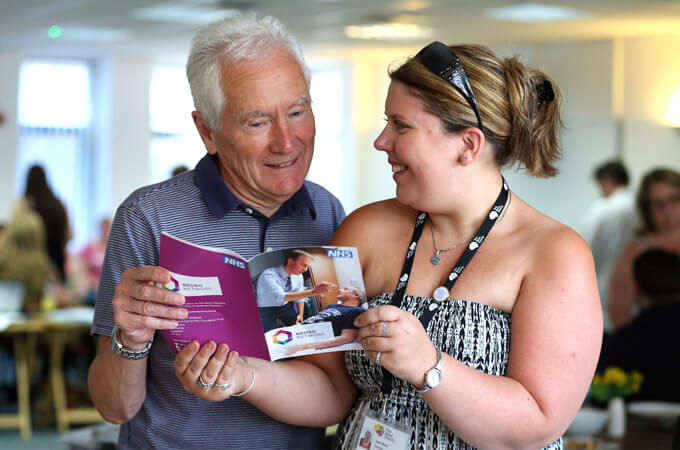
What advice offers in those moments isn’t just technical expertise — it’s humanity. Dr Mulqueen shared a quote from a research participant who’d received advice:
“They make you feel welcome. They make you feel at ease; they take the pressure off you. If you don’t fully understand what they’re saying to you, they will take it on themselves.”
That sense of being listened to, believed, and supported is at the heart of our work. For people living with neurological conditions, being able to take things at their own pace, ask questions, and feel safe admitting confusion can make all the difference.
The speech also highlighted something that often goes unrecognised: advice doesn’t just support individuals, it strengthens entire communities. Frontline organisations — from food banks to healthcare providers — rely on advice services as partners who “get it” and understand the broader context of people’s lives.
And yet, despite overwhelming evidence of its impact, the advice sector continues to face chronic underfunding and insecurity.
As Dr Mulqueen asked:
“How is it that we can know these things so well, but continually face precarity and reductions in funding in this sector, alongside the seemingly endless need to demonstrate the worth and value of advice?”
Why statutory welfare advice matters
This is why the call to make welfare advice a statutory duty matters so much. When systems like benefits, housing, healthcare and employment build access to advice in from the start, fewer people reach crisis point. Rights move off the page and into real life.
As we left Parliament that evening, we felt both inspired and resolute — inspired by the dedication of advisers across the country, and resolute in our belief that this work is not a charitable ‘extra’, but essential infrastructure.
At The Brain Charity, our Info & Advice team will continue to stand alongside people affected by neurological conditions, helping them navigate systems that are too often inaccessible. And we will continue to add our voice to calls for change, so that one day, no one is left to face these challenges alone.
Because advice doesn’t just solve problems, it prevents them. And as that evening so powerfully reminded us, it helps hold lives together when things threaten to fall apart.
Share your experience
If you or someone you care about has received welfare advice from The Brain Charity’s info & advice team, we would like to hear your story. Please email communications@thebraincharity.org.uk.
 Share
Share
 Tweet
Tweet
Related information